Researchers went back to check Palestinian casualty reports from October 2023. They found a deadlier month for civilians—and children—than any other chapter of the “war on terror.”
Matthew Petti | 12.13.2024 11:57 AM
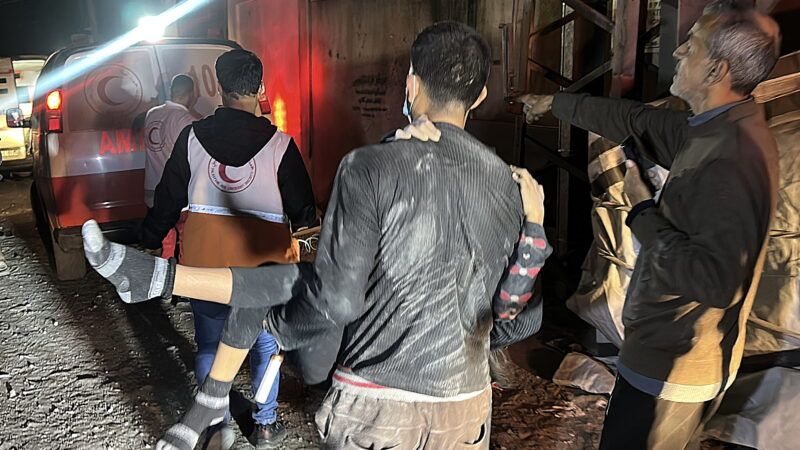
How many people in Gaza have been killed by the Israel-Hamas war? For a long time, the only source of information was the Palestinian Ministry of Health. And the accuracy of their death rolls became the subject of a morbid political debate. Is it fair to call the ministry “Hamas-run“? Did they tell the truth about the Ahli Hospital bombing? What to make of the discrepancy between identified and unidentified corpses?
It’s an ethical question not just for Israelis carrying out the war, but also for Americans, who are providing both the funding and weapons that make the war effort possible.
Airwars, a team of conflict researchers affiliated with the University of London, went back and cross-checked the casualty lists from the first 25 days of the Israeli air campaign against news reporting, social media, and other local sources. And unlike the Palestinian ministry, they differentiated between civilians and fighters, using data such as social media funeral notices to determine Hamas affiliation.
The Airwars report, released on Thursday, shows a rate of civilian slaughter “incomparable with any 21st century air campaign. It is by far the most intense, destructive, and fatal conflict for civilians that Airwars has ever documented.” The Palestinian ministry reported 8,525 wartime deaths, including 3,542 children, from October 7, 2023, to October 31, 2023. Airwars was able to verify a minimum of 5,139 civilians killed by Israeli air raids in that timeframe, including at least 1,900 children.
Most of them were not the collateral damage of combat against Hamas. Out of 606 incidents of civilian casualties studied by Airwars, only 26 overlapped with the death of a militant. And in those 26 incidents, the killing was still incredibly lopsided, with 32 militants killed in total, at a cost of 522 civilian lives.
For example, the Israeli military killed Hamas commander Ibrahim Biari on October 31, 2023, by dropping American-made 2,000-lb bunker buster bombs on the Jabalia refugee camp. The attack also killed at least 126 civilians, including 69 children, according to Airwars. “Children were carrying other injured children and running, with grey dust filling the air. Bodies were hanging on the rubble, many of them unrecognized. Some were bleeding and others were burnt,” Palestinian eyewitness Mohammad Al Aswad told CNN at the time.
Israeli military spokesman Lt. Col. Richard Hecht called the deaths in Jabalia a “tragedy of war” in a CNN interview. “About the civilians there, we’re doing everything we can to minimize. Sadly they [Hamas] are hiding themselves within the civilian population,” Hecht told CNN. “We’re going to go after every one of these terrorists who was involved in the hideous [October 7, 2023] attack.”
Hamas raided Israeli towns and villages on October 7, 2023, killing 815 civilians, including 36 children, and 380 military personnel. Its fighters shot Israelis and foreigners in their houses, bomb shelters, and music festivals at close range, returning to Gaza with 251 captives, about 96 of whom are still being held hostage. The human rights organization Amnesty International said that Hamas “flagrantly violated international law and displayed a chilling disregard for human life by carrying out cruel and brutal crimes including mass summary killings, hostage-taking, and launching indiscriminate rocket attacks into Israel.”
Full Post by Matthew Petti @ Reason https://reason.com/2024/12/13/the-war-in-gaza-is-far-worse-than-you-thought/
 California Libertarian Report